Why Privacy, Not Size, Drives Premium Rates in Nature Hospitality
The luxury hospitality market has shifted. The travellers willing to pay €400 to €600 per night are not looking for larger rooms or more amenities. They are looking for immersion — the feeling of having a landscape entirely to themselves, of waking to birdsong rather than corridor noise, of architecture that dissolves the boundary between interior and exterior.
For investors evaluating nature hospitality projects, this shift has a direct financial implication: the most profitable accommodation units are not the largest. They are the most intimate.
The ECOSUITE 36: Premium Returns Through Experiential Design
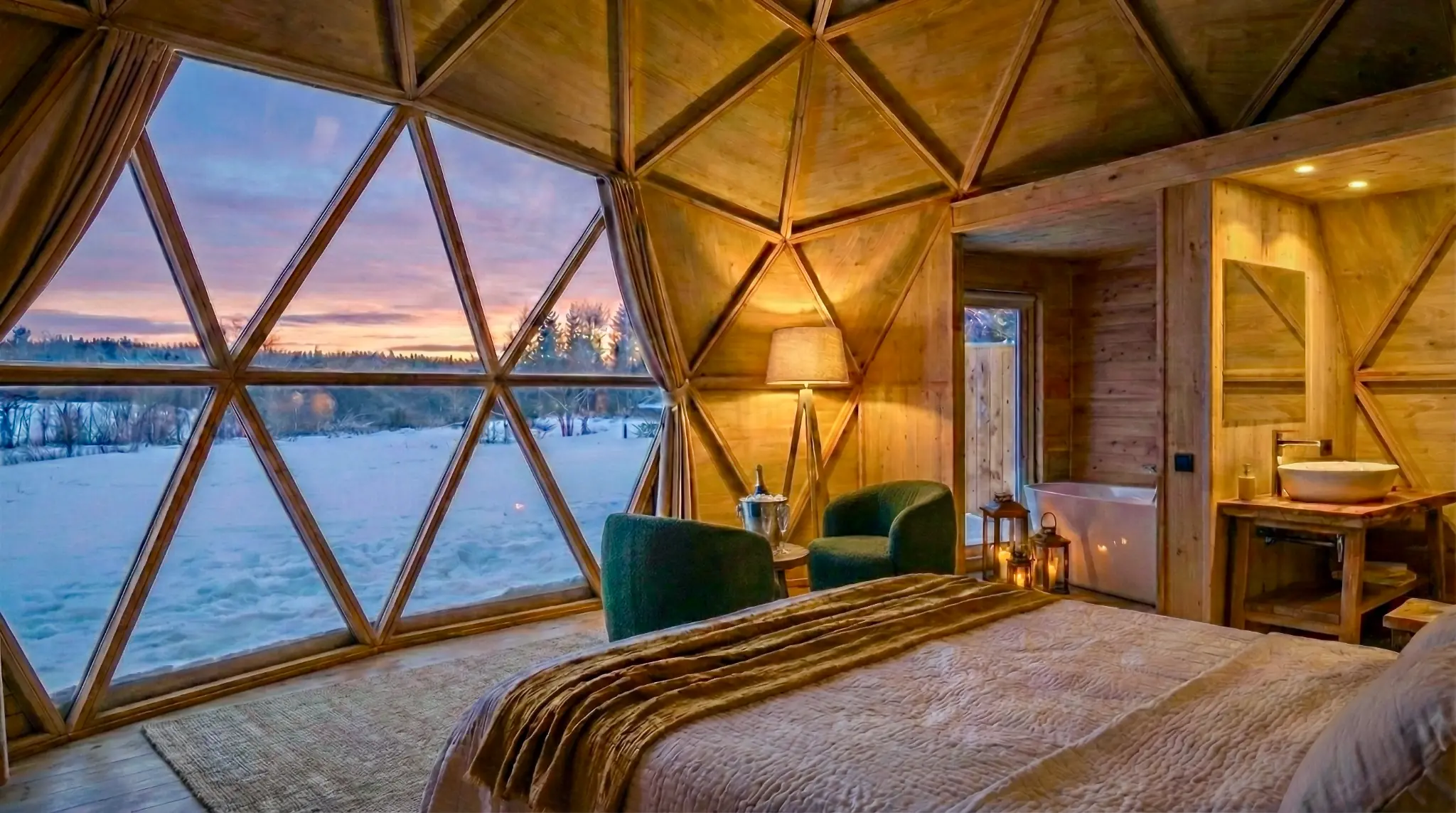
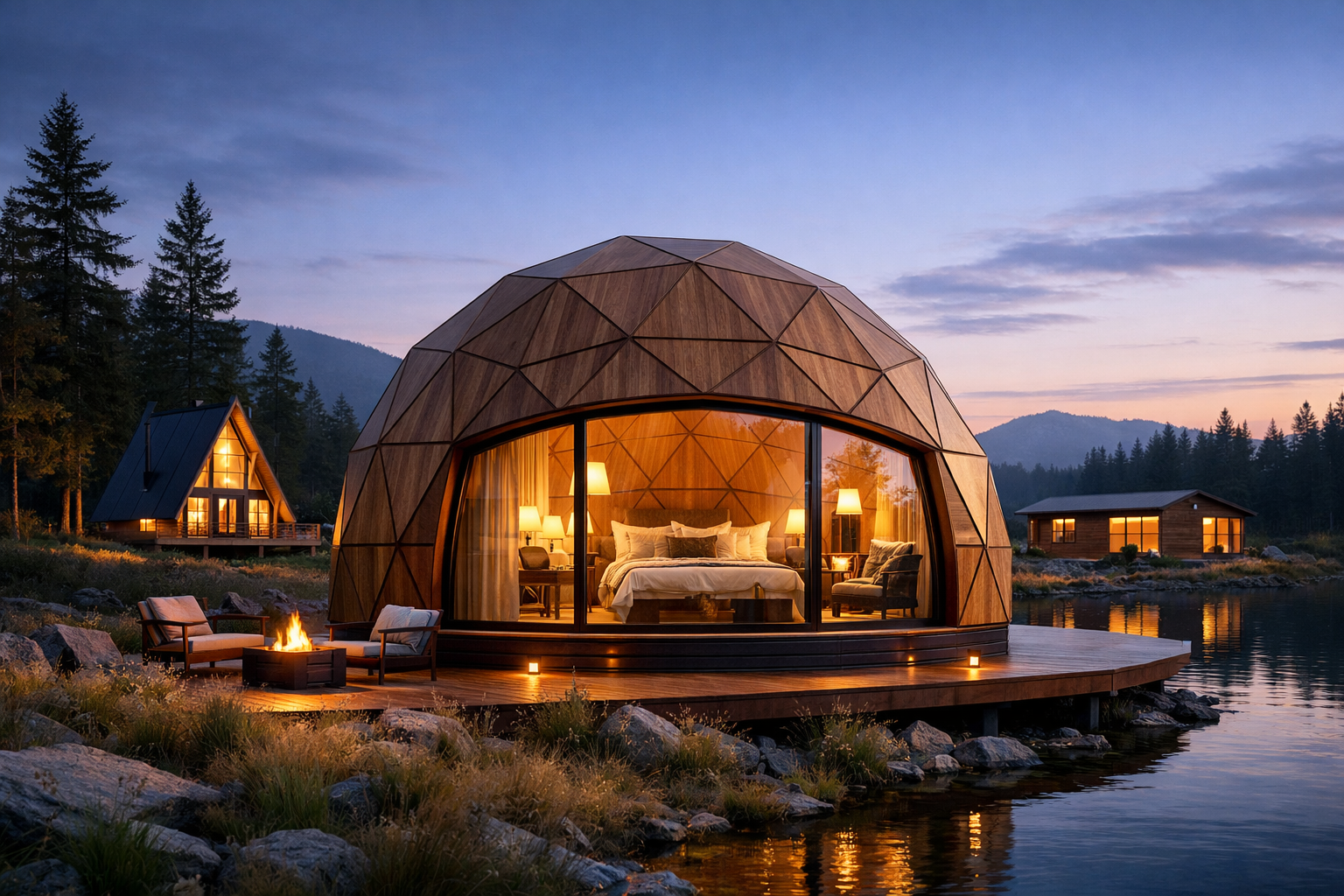
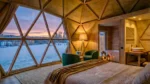
The ECOSUITE 36 — a 36-square-metre geodesic timber suite with a 7-metre diameter — demonstrates this principle clearly. At its core, it is a private retreat: full bathroom, living area, and panoramic glazing that frames the landscape like a continuously changing painting.
Across European markets — Portugal, southern France, northern Spain, the Swiss Alps — units of this type consistently achieve ADRs between €350 and €550. The rate is not driven by square metres. It is driven by the quality of the experience: the geometry of light through triangulated timber panels, the acoustic privacy of individual structures set 30 to 40 metres apart, the sense that nature is not a backdrop but a participant.
CapEx, ADR and the 30-Key Sweet Spot
After 24 years developing nature hospitality projects, we have identified a clear financial sweet spot: resorts of approximately 30 keys. This number balances capital expenditure against operational costs in a way that maximises investor returns.
Below 15 units, the fixed costs of common infrastructure — reception, restaurant, wellness facilities — weigh too heavily on each key. Above 50, the intimate character that justifies premium rates begins to erode, and operational complexity escalates disproportionately.
At 30 keys with ECOSUITE 36 units, the economics are compelling. At an ADR of €400 and 65% annual occupancy, the resort generates approximately €2.85 million in gross revenue. Operating costs for a lean nature lodge — typically 35% to 45% of revenue — leave a net operating income between €1.57 million and €1.85 million. Payback on the structures themselves can occur within 12 to 18 months.
Regenerative Tourism: The Demand Driver
The growth in experiential and regenerative tourism is not a trend — it is a structural market shift. Guests are no longer seeking escape. They are seeking regeneration: physical recovery, sensory recalibration, reconnection with natural rhythms.
This demand profile favours architecture that actively participates in the experience. Geodesic structures — with their natural ventilation, passive solar design, timber materiality and geometric precision — create spaces where guests feel the environment rather than being shielded from it. The triangulated form of the ECOSUITE 36 filters light in patterns that change throughout the day, creating an interior atmosphere that is alive.
For the investor, this translates into repeat bookings, higher direct booking ratios, and organic social media visibility that reduces customer acquisition costs year after year.
Occupancy Scenarios Across European Markets
Conservative (55% occupancy, €350 ADR): A 30-unit resort generates approximately €2.1 million annually. NOI reaches €1.15 million to €1.36 million.
Base case (65% occupancy, €400 ADR): Annual revenue of €2.85 million, with NOI between €1.57 million and €1.85 million.
Optimistic (75% occupancy, €500 ADR): Revenue approaches €4.1 million, with NOI exceeding €2.25 million.
Architecture as Revenue Engine
Iconic architecture is not a cost — it is the primary revenue driver in nature hospitality. A geodesic dome in a forest clearing is inherently photogenic, shareable and memorable. This creates a compounding organic marketing effect that reduces acquisition costs over time.
The ECOSUITE 36, engineered with Angular Domos’ V2 subdivision system for optimal load distribution, arrives pre-fabricated and pre-numbered. Assembly takes 15 to 20 days per unit with a crew of four. No heavy foundations, no concrete, no months of construction delays. The structure is the experience.
Exploring a nature hospitality investment? Book a strategic call to discuss your project at angulardomos.com.